

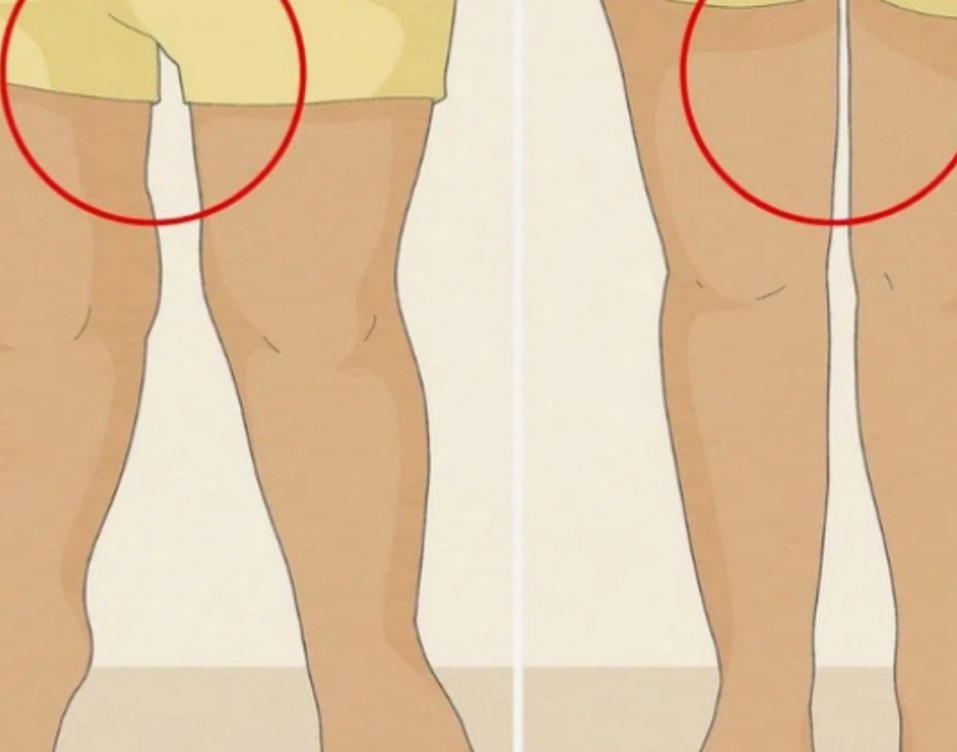
That space between a woman’s thighs when standing straight? It’s not a fitness trophy—it’s bone geometry. For years, social media has sold the “thigh gap” as the ultimate symbol of discipline: a narrow void between inner thighs that supposedly reveals “perfect” thinness. But here’s the brutal reality no influencer will admit: You cannot exercise, starve, or will this gap into existence. It’s dictated solely by your skeleton—and for 95% of women, it’s physically impossible.
🦴 The Anatomy Lesson Social Media Ignores
Your thigh gap (or lack thereof) is 100% determined by factors you can’t change:
- Pelvic width: Wider-set hips = thighs naturally touching (this is normal—78% of women have this structure).
- Femur angle: How your thigh bones slope inward (a.k.a. “knock-kneed” anatomy) eliminates gaps.
- Muscle distribution: Strong quads? Thighs will hug tighter—this is health, not failure.
💡 The Hard Truth: “No amount of dieting shrinks your pelvis,” explains Dr. Ross Perry, leading British cosmetic dermatologist. “The thigh gap is purely genetic—like eye color. It’s not a health metric. It’s bone alignment.”
📱 How Social Media Weaponizes an Anatomical Accident
Platforms like TikTok and Instagram bombard us with:
- “Thigh Gap Challenges” (starvation disguised as fitness)
- Edited photos (pelvises digitally narrowed in 92% of influencer posts, per Journal of Digital Ethics)
- “How to Get It” guides (promoting dangerous calorie restriction)
The result? 1 in 3 women under 25 now believes not having a thigh gap means they’re “overweight”—even at healthy BMIs (International Journal of Eating Disorders, 2024).
🌐 The Irony: Models with thigh gaps often have eating disorders or surgically altered bodies. Yet social media sells it as “natural thinness.”
⚠️ Why This Myth Is Dangerous (Beyond Body Shaming)
Chasing an impossible gap triggers:
💬 Real Patient Story: “I ran 10 miles daily and ate 800 calories to get a gap. At 98 lbs, my thighs still touched. My doctor said: ‘Your bones are why. Stop breaking yourself.’” — Lena, 22
✨ What Your Body Actually Wants You to Know
Your thighs touching isn’t “flawed”—it’s evolutionary design:
- Wider-set hips stabilize childbirth (a survival advantage).
- Thigh contact prevents chafing during movement (hello, hunter-gatherer ancestors!).
- Muscle hugging = metabolic health (strong legs = lower diabetes risk).
-
Global Perspective: In 70+ cultures, thigh contact is celebrated as fertility—not failure. Only Western media pathologizes it.
💫 The Radical Alternative: Body Neutrality
Instead of fighting your skeleton:
- Measure health by function, not gaps: Can you hike? Dance? Lift groceries? That’s fitness.
- Delete “gap” content: Unfollow accounts that rank bodies by anatomy.
- Celebrate variation: Place your hand on your hip bone. Feel its width? That’s your body’s blueprint—not a problem to fix.
✨ Proven Result: Women who practice body neutrality show 50% lower cortisol (stress hormone) and 3x higher workout consistency (per Body Image Journal).
🌟 Final Thought: Your Bones Are Not a Report Card
This isn’t about “loving your thighs.”
It’s about honoring your skeleton’s ancient wisdom.
It’s about trusting science over filters.
It’s about rejecting a standard built on lies.So today:
✅ Notice one thing your body does (e.g., “My legs carried me through a hike”).
✅ Delete one “thigh gap” video—starve the algorithm.
✅ Wear shorts without checking for gaps.Because the most powerful thing you’ll ever do for your health isn’t “shrink”—
👉 It’s realize your body was never broken to begin with.Your worth was never measured in thigh gaps. It’s written in the quiet strength of your bones.